Part III · Peace in Practice
What Local Ownership Requires of Non-Locals
Eighteen years of partnership with Fambul Tok in Sierra Leone demonstrate what it actually means to center local leadership — and what non-locals must do, and give up, to make it real.
For international peace and development to be more locally-led, we need to give more time, thought, money and care to cultivating and embodying the systems needed to support local leadership, and to understanding what these systems ask of both locals and non-locals.
Until we do, we risk “localization” being nothing more than glorified branding, while an externally-driven aid system continues to ignore and undercut local agency and capacity, fragment communities, and entrench dependency on outside aid. Meanwhile external actors, including policymakers and donors, will continue to see themselves as being outside of and separate from the systems of transformation. This allows them to avoid the necessary but messy work of building and inhabiting healthy, whole systems that can be life-giving for all.
In this article, I’m going to share key lessons from our 18-year partnership with Fambul Tok in Sierra Leone, where we have built and lived into a whole system of local ownership, in practice, at a national scale. Catalyst for Peace, the US based operating foundation I founded in 2003, has been a funding and program partner for Fambul Tok since its inception in 2007. We have accompanied the growth of the program from post-war community healing to what is now a national policy framework for people-led planning and development, and from village to district to national and even global levels. We have brought to life, in practice, the paradigm, principles and practice of an inside-out framework for peacebuilding and development, which stands in contrast to the outside-in system that currently dominates.
Imagine that a community is like a bowl. Humanitarian aid, whether at a local, district, national or international level, is like a bottle of water. When there is a crisis, water (aid) gets poured into the bowl – but it goes right through. That’s because the bowl — the community container itself — is cracked. And if you keep pouring water into a cracked container, it widens the cracks. It heightens local distrust of outsiders and further disrupts communities’ connection to their own resources and agency, while also depleting the water (the aid and those giving it) in the process. This is not a good cycle for anyone.
In Catalyst for Peace’s 18-year partnership with Fambul Tok, our work has never been about pouring water in. It’s been about repairing the container.
What we have seen is that when you repair the community container, not only can the community retain the water being poured into it, but it actually becomes like a well – able to tap into the reserves of groundwater right there, unleashing the community’s own resources and energy to lead its recovery and ongoing renewal and development.
So how do you repair the container? Of course that depends on the context and the goal. But regardless of context you first have to see and center the bowl itself – that is, the community.
Seven years after the end of its 11-year civil war, Fambul Tok was created to step into the gap left by the formal justice mechanisms the international community supported to bring justice and peace to Sierra Leone: the Special Court of Sierra Leone and the Truth and Reconciliation Commission. Neither of those processes effectively reached or engaged the people and places most impacted by the brutal civil war. Much of the population lived in the same community as someone who might have killed or raped a family member, amputated a limb, burned down the community center, or committed other egregious harm to them or those they loved – and they had never talked about what happened.
In that context, “repairing the bowl” meant first convening locally respected leaders from those places most impacted by the war, representing both victims and perpetrators (as in any civil war, the line between those two categories was typically thin and fluid), and asking them if, and how, they wanted to reconcile.
When representative local leaders were asked if they wanted to reconcile, the answer was universally a resounding ‘Yes’.
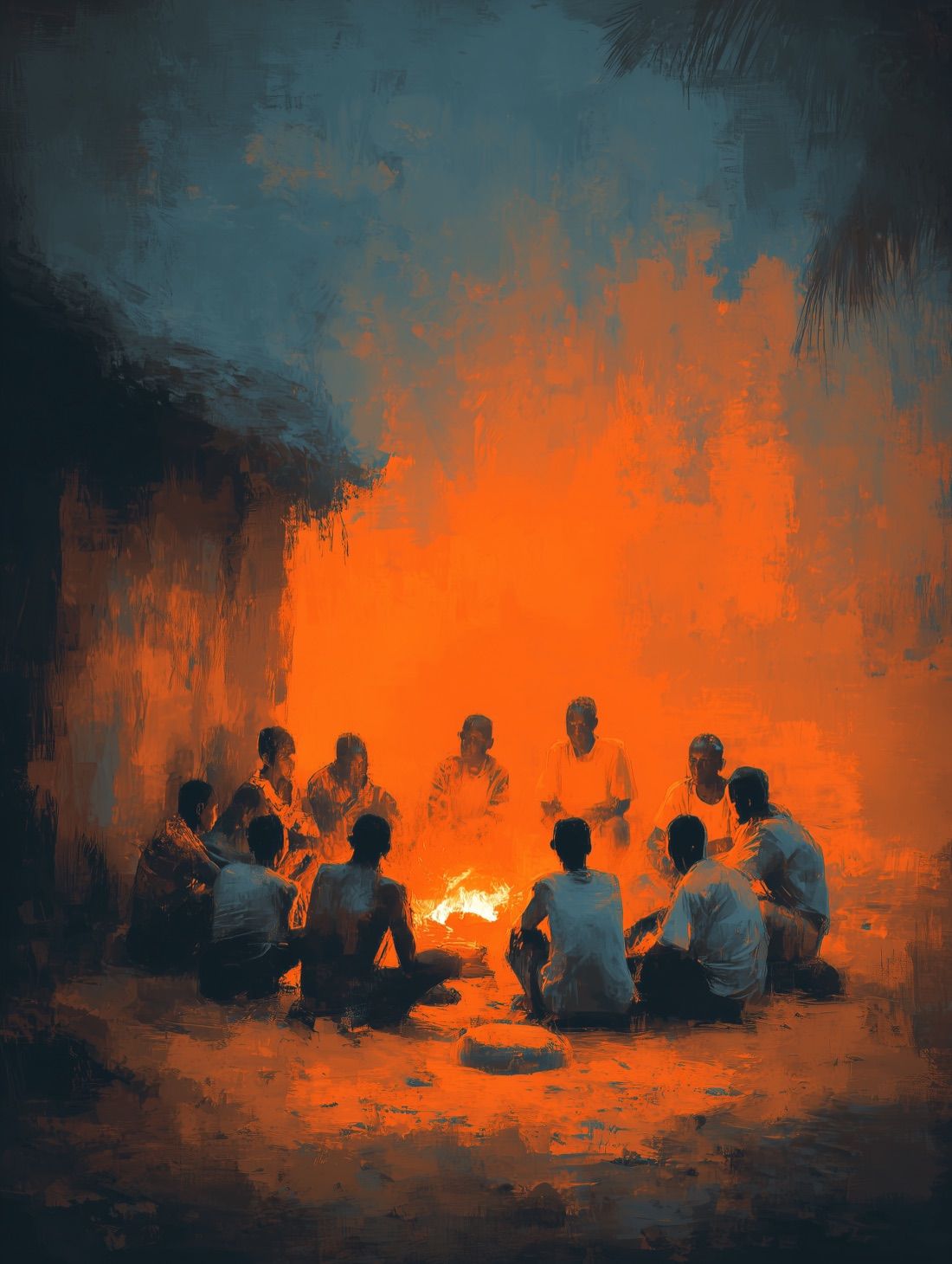
When asked how they wanted to do so, and what resources they might already have to do so, the answer was universally that they had rich cultural traditions of fambul tok, or family talk — of coming together as a community around a bonfire, to solve problems through conversation. They wanted to turn to their own, indigenous restorative justice process of communal truth-telling, apology and forgiveness. In addition, communities noted a rich variety of cultural cleansing traditions, both individual and communal, many of which had gone dormant during war, and which they wanted to revive and adapt to support community healing.
And when asked what help they needed from the Fambul Tok staff in order to move forward with a process like this, the answer was to hold the container for the process, until they could hold it themselves.
With a skeletal national staff, Fambul Tok used a staggered consultation, facilitation and mobilization process to build the infrastructure of local leadership and ownership. They consulted and organized first at the district level (comparable to states in the US), then moved to the chiefdom level (comparable to counties in the US, and the seat of the widely respected traditional Paramount Chiefs), and only then focused community mobilization at the section level, a collection of neighboring villages and the level at which the traditional fambul tok healing bonfires were held.
Over the next six years, Fambul Tok helped facilitate over 250 community healing bonfires, reaching over 2,500 villages, with over 150,000 people participating directly in the process and its follow up. Besides the ceremonies themselves, the process as Fambul Tok facilitated it left behind local infrastructure to carry the reconciliation and renewal forward – including community mediation teams of trusted neighbors who could support addressing any new challenges that arose; Peace Mothers groups to help women heal from the wounds they uniquely suffered in the war, and to harness their leadership in community development going forward; and community farms, which became centers for locally-led development and channels for cementing the reconciliation process started around the bonfire.
Fambul Tok helped each community organize those structures, and then it stepped back to let the villages take them forward on their own – which they are. In places where Fambul Tok hasn’t had any active presence for years, Peace Mothers groups and community farms, for example, are still active and growing and strengthening their communities.
Key Outsider Roles — locally, nationally and globally
As a national organization, Fambul Tok staff were “outsiders” in the local contexts where they worked. At the local and national level, the key outsider roles they needed to carry out to initiate, support and sustain a locally-led process included:
- A commitment to going to the places and walking with the people most impacted by the war, instead of designing responses from a faraway capital;
- Seeing and valuing the communities’ resources and untapped potential, whether physical, cultural, people-wise, and/or relational;
- Inviting the communities to define their own vision (including defining the problem and naming desired solutions themselves); and
- Establishing nested structures of inclusive local leadership (in this case, from district through chiefdom to section/village), to run the process and be able to embed it in the community ongoingly after Fambul Tok left.
- Critical to ensuring a trustworthy process, Fambul Tok took on another role, that of establishing and inculcating core process-values to ensure that everyone’s voice was included and that the process wouldn’t get co-opted by politics or entrenched cultural norms that, for example, excluded or subjugated women or youth.
The general orientation of Fambul Tok’s approach was elicitive and invitational, while also being prescriptive in a few key areas, notably around values and process rules, in order to ensure the ongoing integrity of the process. This was critical to repairing the community bowl – healing from harm, reknitting relationships of trust and reawakening the capacity for collaborative action on behalf of the whole.
Fambul Tok, in turn, had its own container, holding, tending and supporting the ongoing growth and adaptation of the work and the organization itself – the Fambul Tok-Catalyst for Peace partnership. Parallel to the local level roles, our experience shows that at the national and global level there were also key outsider roles needed to initiate, support and sustain a locally-led process at a national scale:
- One obvious and critical one was creating a long-term funding container within which the work and organization could grow organically and adapt to changing political and social realities. Catalyst for Peace was a primary funder of Fambul Tok for 12 years and offered occasional smaller bridging grants for 5 more years, while also helping cultivate a broader funding base. This long-term funding was especially important in helping prevent the work from being co-opted by external forces that might otherwise try to enforce their norms, whether on local communities or on Fambul Tok.
- Catalyst also held a learning and emergent design platform and helped embed that within the national organization. This was made real through convening regular spaces for staff to step away from the frontlines; reflect on what was happening, including the challenges and lessons of work; and be intentional about discerning and designing the next phase of work. Together with the long-term funding, this allowed Fambul Tok to stay grounded in lived experience and to adapt to new political and social realities and opportunities. It also created a place to focus on the partnership itself, tending to relationships and tuning to purpose and vision and values, in an ongoing way.
- We supported organizational development and individual and organizational capacity building, as needed and appropriate.
- We helped build and strengthen the emerging narrative as well as share the stories and lessons with the world, through integrating storytelling — in writing, image and film — into every part of the program (see, for example our documentary film, Fambul Tok). This story-gathering and sharing was directed inwardly, in a way that helped staff and communities see and name what was happening more clearly, as well as outwardly, in a way that illuminated the power, process and potential of the work to a global audience.
- The storytelling also helped grow a global web of connection to other individuals, organizations and initiatives working similarly, strengthening a global community of learning and practice that further magnifies the good and helps resource the whole.
I recognize that I’m barely scratching the surface with these descriptions. It is not my intent to offer a comprehensive list or a replicable how-to of “outsider roles” with this article. For those interested in a more in depth look at the roles and what they look like in practice, see my book, The Answers Are There: Building Peace from the Inside Out (Blue Chair Press, 2022). What I do want to do, however, is illuminate the ways in which the invisibility of the local community container in the humanitarian aid system gets replicated at the national and international level.
For global actors wanting to support local peacebuilding: if we define “local” primarily as a geography, we ignore and invisibilize the importance of the containers that hold, strengthen and evolve locally-led work, and our own roles in creating and sustaining them. And when we do that, we systematically undercut the potential for actually achieving the goal of centering local leadership in peacebuilding and development.
In Catalyst and Fambul Tok’s experience, it is not just the local that is like a bowl. Every level functions like a bowl — a container that helps strengthen and sustain the bowl inside it — and all the bowls are nested within each other, together making up a whole, mutually life-giving ecosystem of support. Each bowl represents distinct locations, roles, resources and needs, and all work together as part of a larger whole.
A systemic view of local ownership requires non-locals to be “bowl-holders” – to create and hold strong containers that support the emergence of local community agency and creativity.
Let’s make the containers that support (or are needed to support) locally-led peace and development more visible. And let’s be intentional about naming and practicing the work of bowl-holding, at every level. As we tend to these bowls and roles explicitly, courageously and creatively, we will make real the potential of people, communities and culture – and thereby the world.
Libby Hoffman · Catalyst for Peace / Fambul Tok
Libby Hoffman is the founder and president of Catalyst for Peace, a co-founder of Fambul Tok in Sierra Leone, and author of The Answers Are There: Building Peace from the Inside Out (Blue Chair Press, 2022).