Part IV · The Future of Peacebuilding
Reimagining Security from the Ground Up
Elinor Ostrom won a Nobel for showing people cooperate without coercion — Gregory asks why the security field still designs institutions as if they don't.
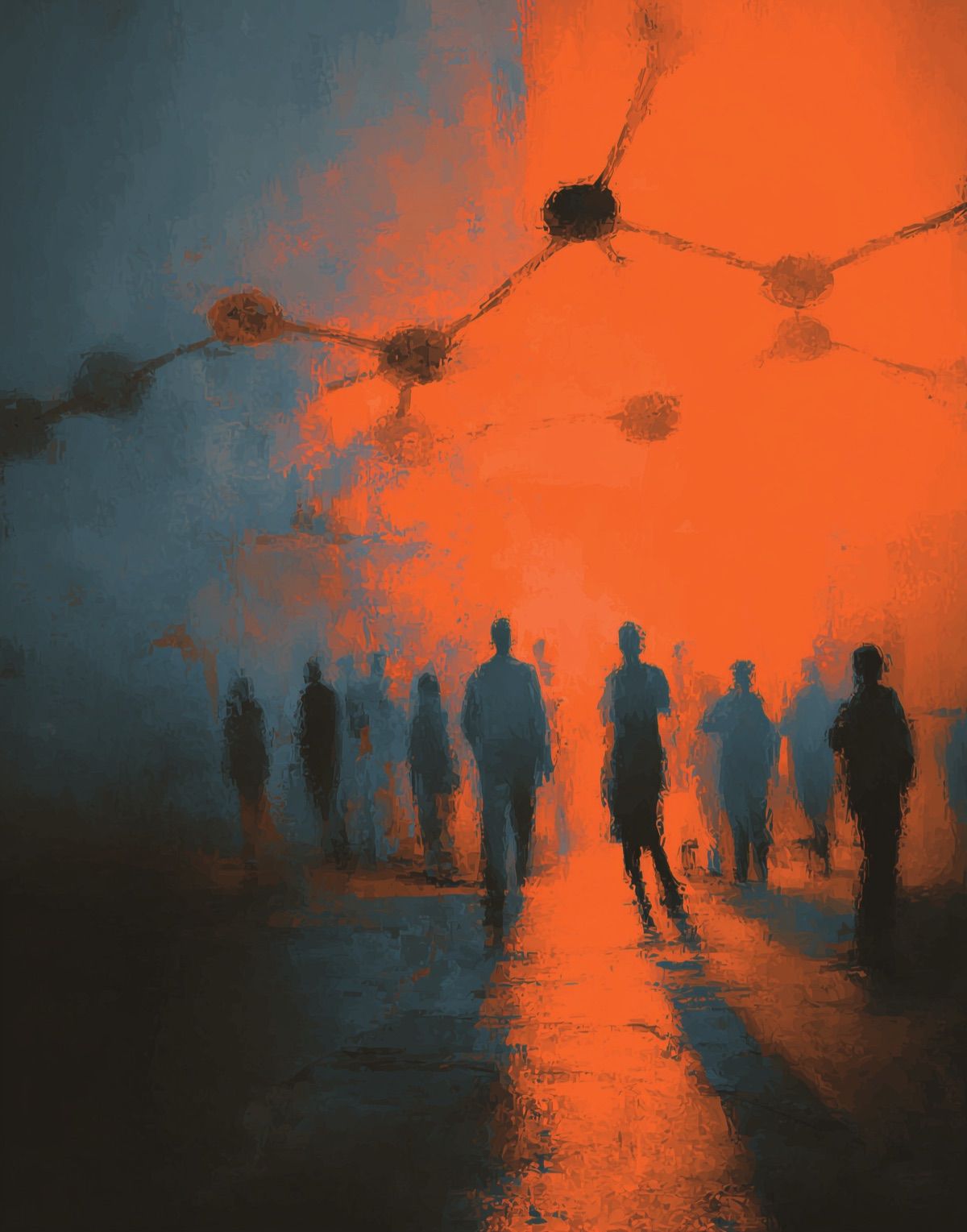
Horizon 2045 and Women Transforming Global Security are turning previous assumptions about global security and human nature upside down to build a framework for the world’s future institutions. Here’s what they are learning.
At the January 2026 gathering in Davos, Canadian Prime Minister Mark Carney announced what many had been thinking: the rules-based international order has not experienced a transition. It has experienced a break and it “is not coming back.”
For those of us working to prevent today’s compounding crises from becoming tomorrow’s catastrophes, this resonates. Institutions, treaties, and doctrines built after 1945 were designed for a world of competing states maintaining stability through mutual deterrence. Today they are no longer fit for this purpose.
Climate tipping points are arriving decades sooner than predicted. New pathogens emerge every one to two years, often jumping from animals to humans. Autonomous weapons systems make lethal decisions without human oversight. Active wars continue on multiple continents. Nuclear signaling has returned to mainstream geopolitical discourse, and mass atrocities proceed largely unchecked.
What makes this moment different from previous ones is the compounding nature of threats. Nuclear instability hinders climate cooperation. Climate stress accelerates conflict. Democratic erosion weakens every other defense. Despite this, the $225 million that nuclear-armed states are spending a day, continues to flow through institutions that are designed as if these threats were discrete. Leaders are trained in silos, legal systems lag decades behind emerging harms, and philanthropy often funds cleanup rather than prevention. This is costing lives.
The problem in the peace and security sector is not ignorance. We have sophisticated analytics about how existential risks entangle and cascade. What stops us from changing course is fragmentation: the structural gap between the pace of risk and the pace of institutional change, and between high-quality expertise and timely, coordinated action.
This is the gap Horizon 2045 was built to close.
“History shows this: apartheid in South Africa persisted despite moral opposition because legal frameworks lagged decades behind courageous leadership.”
The Three Levers We Need To Coordinate
There are three interdependent levers of change that need to be connected in today’s world to meet the future: leadership, developing leaders who can navigate entangled risks across sectors; legal innovation, creating accountability tools before crises force reactive measures; and adaptive philanthropy, redirecting capital toward anticipatory action rather than post-crisis relief. Horizon 2045 works at the intersection of all three.
Imagine a senior diplomat is navigating a regional conflict that is simultaneously a climate crisis, a pandemic risk, and a nuclear flashpoint. They have a shared analytical framework with their counterparts in health, environment, and finance ministries. Their legal team can draw on precedents from climate litigation and human rights law to create accountability where no treaty yet applies. And the philanthropic capital supporting their work actually arrived three years before the crisis peaked which enabled them to fund the relationships and early warning systems that made coordination possible when it mattered most. In this reality, the senior diplomat would be adequately prepared and resourced to meet the complex challenge head on before lives were severely threatened.
Unfortunately, this is not our current reality. But it can become our future one, if we coordinate across these three levers of change that currently operate separately. Horizon 2045 was built on this exact premise: that the fragmentation between these key drivers of change is the sector’s biggest obstacle to preparing for future crises. Below is our approach to ending that fragmentation.
Leadership: Seeing The Whole System
Leadership alone cannot fix broken governance, but without it, no reform moves. A leader can recognize harm, organize action, and speak with moral authority, but if laws don’t define or prohibit that harm, advocacy remains symbolic rather than enforceable. History shows this: apartheid in South Africa persisted despite moral opposition because legal frameworks lagged decades behind courageous leadership.
Horizon 2045 cultivates leaders capable of operating across silos, anticipating systemic risks, and acting before crises force reaction. Cognitive diversity, cross-sector experience, and the willingness to challenge entrenched assumptions are as important as seniority or technical expertise. Emerging leaders bring fresh perspectives on climate, technology, and democratic erosion, while seasoned leaders contribute judgment and credibility. Together, they create nodes of collective intelligence that perceive entangled threats early and mobilize coordinated action. In the Women Transforming Global Security (WTGS) project, an initiative co-sponsored by The Elders, Horizon 2045, and Ploughshares, the leaders we work with were selected not only for the quality of their judgment, but the range. They are leaders who can navigate complexity, build trust across differences, and make decisions in fragmented systems. In our view, this type of leadership is structurally transformational because it enables legal norms to gain traction and philanthropic capital to reach leverage points before crises escalate.
Legal Innovation: Naming What Matters
Next, leadership must be paired with legal change. Without legal frameworks, even visionary leadership can stall: harm remains “regrettable,” and accountability is impossible. Lex Mundi Nova develops legal tools anticipating emerging threats, drawing from environmental law, human rights, and intergenerational justice. By naming new violations — like ecocide and AI misuse — the law shapes what leaders can demand and what funders can support.
Philanthropic Capital: Moving Beyond Reactive Funding
Finally, philanthropic capital without leadership and law produces something that looks like progress, but often isn’t. Excellent research gets funded. Reports get written. Convenings happen. But a system that concentrates decision-making power in a small and homogeneous group can absorb well-funded external pressure and change almost nothing. Money can sustain organizations. It cannot, by itself, shift who holds authority or what counts as a legal violation. Some of the most richly funded fields in global security have remained structurally frozen for decades.
When The Three Levers Work Together
When the three levers of law, leadership, and philanthropy work together, they make systemic change possible that cannot be achieved by any one of these levers alone. Legal innovation defines what is nameable and enforceable. Transformative leadership converts norms into political will, providing the credibility and access needed for action. Adaptive philanthropy enables early intervention, connecting actors across sectors at critical moments and ensuring ideas reach the right actors before crises force reactionary action.
Together, these levers form a feedback loop: laws give leaders concrete mandates; leaders give laws political energy; philanthropy funds connections and early action. The result is not merely better crisis response. It is governance designed to prevent crises before they occur.
“When you strip away the theoretical model and look at what people actually do, the picture is not of permanent adversaries calculating defection. It is of neighbors feeding each other.”
The Previous Assumptions We Need To Change
To understand the new direction we are recommending, it’s critical to understand why permeable boundaries, diverse perspectives, and generational pathways have been systematically excluded in the first place. The answer lies in the artifact that has organized security thinking for seventy years. The dominant logic of international security was built on a particular model of human behavior: that individuals and states are fundamentally self-interested, that cooperation is fragile, and that the best achievable outcome is mutual deterrence. This model has a precise origin. It was developed at the RAND Corporation in the late 1940s and 1950s, applied to nuclear strategy, and then exported through game theory into economics, political science, and the design of global governance itself.1
As the scholar S. M. Amadae has documented, this was not a neutral scientific discovery. It was an ideological artifact of the Cold War, an adopted fiction about human nature that happened to be useful to a particular set of strategic interests.2 The Prisoner’s Dilemma — an assumption adopted during the Cold War that has since masqueraded as truth — placed a single dismal assumption at the center of our views, and framed what was seen as possible.
The empirical record establishes that this view of human behavior is a myth though. When you strip away the theoretical model and look at what people actually do, the picture is not of permanent adversaries calculating defection. It is of neighbors feeding each other. Elinor Ostrom won the Nobel Prize in Economics for demonstrating, with data from communities around the world, that people consistently develop cooperative institutions to manage shared resources, without the coercion game theorists predicted was necessary.3 The CAF World Giving Report consistently shows that people in low-income countries give the highest share of their income, and 40 percent of global giving goes directly person to person.4
This matters because a security framework built on the wrong model of human nature systematically underestimates what is possible and excludes the knowledge most relevant to durable solutions.
Security conceived around relationality and accountability to future generations can produce more durable outcomes than security conceived around threat, deterrence, and the protection of state power. Decades of research confirms what diverse practitioners have long known: the quality of solutions depends directly on the range of perspectives brought to bear on them. Leaders trained to operate across disciplines, power structures, and worldviews don’t just make better individual decisions. They become nodes of collective intelligence, perceiving interconnected risks earlier, enabling coordination where silos once produced decision paralysis.
The truth is the knowledge needed to navigate this moment already exists. The communities, women, and Indigenous peoples who have been treated as incidental to security decisions are precisely the people whose lived experience of building cooperation under duress is exactly the data we need. The question is whether our institutions are organized to access and act on it.
How Cognitive Diversity Supports Durable Solutions
What the research on complex problem-solving makes clear, is that the quality of solutions depends directly on the diversity of the people constructing them. Not diversity as a values commitment, though it is that too, but diversity as a structural requirement for accurate perception. Scott Page’s work on social systems5 demonstrates that cognitively diverse groups, people who have worked across different fields and bring genuinely different frameworks to a problem, outperform homogeneous groups of individually talented specialists. The reason is straightforward: specialists who share a professional formation share its assumptions, including its assumptions about what is impossible. People who have moved across domains and sectors develop something different: pattern recognition that travels. They notice when a problem that looks new in one field has already been partially solved in another. They see the connections that single-domain experts, however brilliant, are structurally positioned to miss.
This is why permeable boundaries matter as much as diverse faces. Ideas need pathways across sectors. A peacebuilder’s relational methodology shouldn’t take decades to reach a nuclear negotiator. A public health framework for behavior change shouldn’t have to be rediscovered by the democracy field. When people move across domains, when careers are built on range rather than depth alone, those pathways open. The knowledge circulates.
The generational dimension of this is equally urgent and equally underserved. Young people working on climate, technology, and democratic erosion are not apprentices waiting their turn. They are often the people with the sharpest cultural intelligence about the moment we are actually in, because they have grown up inside it. The assumption that leadership accrues with seniority, that the person who has spent the longest time in a field is the person best positioned to lead it through a rupture, is precisely the assumption that moments like these expose as being incomplete. What a rupture requires is not mastery of the world that is ending. It is the capacity to perceive and act in the world that is arriving. That capacity is not distributed by age.
None of this is an argument against experience. Genuine leadership ability, the capacity to hold complexity, build trust across differences, make decisions under uncertainty, and sustain coalitions through failure, is real, rare, and not the same thing as having accumulated seniority in an issue area. What we need are people who are genuinely gifted at leadership itself, not people who have attained leadership status because they have logged the most years in a single domain. The distinction matters because the threats we face don’t reward institutional longevity. They reward the ability to see the whole system, to recognize patterns across fields, and to act before the crisis makes the choice for you.
The principles animating our work with Women Transforming Global Security — including relationality, care, plurality, coherence, entanglement, and accountability across time — are intended to deliver on this premise. WTGS brings together women who have led across sectors and geographies. The Nuclear Futures Fellowship we run with Ploughshares is designed to create real pathways to consequential work for the next generation, not ceremonial inclusion. And the Lex Mundi Nova initiative draws on legal innovation from environmental law, human rights, and indigenous rights precisely because the ideas that will reshape security governance are not going to come from inside the security field. They are going to travel in from the edges, carried by people who learned them somewhere else.
Each of those design choices reflects the same underlying conviction: that the fields most resistant to change are the ones that have been most insulated from the free movement of ideas and people most likely to change them.
Security As Humanity and Resilience
In ecology, a gap event is the moment after a forest canopy falls when light reaches the ground and everything that grows next gets to define the forest. The institutions built after 1945 are visibly crumbling. What grows in their place is not yet determined.
Horizon 2045 is planting the seeds for a specific future in which security is understood not as the protection of states from each other, but as the conditions under which people and living systems can thrive. Security that is horizontal rather than hierarchical, intergenerational rather than immediate, participatory rather than concentrated, and genuinely protective of human and planetary flourishing. In the words of UN Under-Secretary-General for Disarmament Affairs Izumi Nakamitsu, this type of security will emerge from recognizing we need new approaches and definitions that move beyond state-centric thinking to prioritize long-term human survival and planetary stability.
This is distinct from the vision of peace offered by the post-1945 world order, which emphasized the absence of hot war among major powers over the presence of genuine safety for most of the world’s people.
The peace worth building is not a negotiated truce between adversaries. It is something closer to what Arundhati Roy named: “peace as the sibling of justice”. To support more of the world’s population, security should be reconceptualized as care, extended forward in time and outward to every living system with whom we share this planet.
Footnotes
-
Fred Kaplan, The Wizards of Armageddon (New York: Simon & Schuster, 1983); Sharon Ghamari-Tabrizi, The Worlds of Herman Kahn (Cambridge, MA: Harvard University Press, 2005). ↩
-
S. M. Amadae, Prisoners of Reason: Game Theory and Neoliberal Political Economy (Cambridge: Cambridge University Press, 2016); and Rationalizing Capitalist Democracy: The Cold War Origins of Rational Choice Liberalism (Chicago: University of Chicago Press, 2003). ↩
-
Elinor Ostrom, Governing the Commons: The Evolution of Institutions for Collective Action (Cambridge: Cambridge University Press, 1990). ↩
-
Charities Aid Foundation, CAF World Giving Index 2023 (London: Charities Aid Foundation, 2023). ↩
-
Scott E. Page, The Difference: How the Power of Diversity Creates Better Groups, Firms, Schools, and Societies (Princeton, NJ: Princeton University Press, 2007); and The Diversity Bonus: How Great Teams Pay Off in the Knowledge Economy (Princeton, NJ: Princeton University Press, 2017). ↩
Erika Gregory · Horizon 2045 / Women Transforming Global Security
Erika Gregory is President of Horizon 2045 and Co-Director of Women Transforming Global Security.